Tuesday, February 09, 2010
Brudirect News1
Brudirect News2
HYS Topics...
   
Text Size

Content on this page requires a newer version of Adobe Flash Player.

Get Adobe Flash player

Hong Kong Bank Banner
RBC Banner

$22m Masterplan To Expedite BIMP-EAGA Initiatives

bimp-eaga
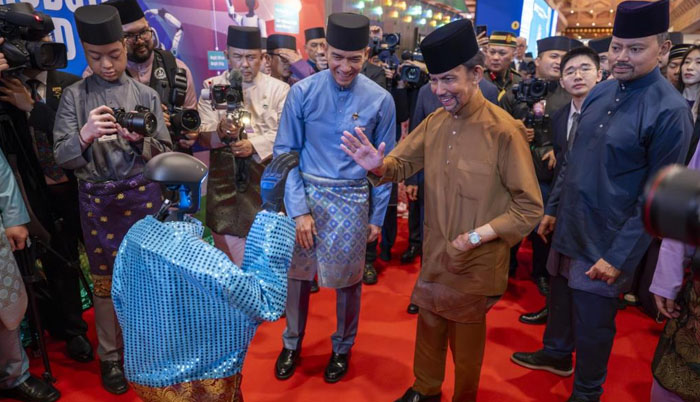
Chairing the meeting: Minister of Foreign Affairs and Trade H, Pehin Dato Lim Jock Seng (C), chairs the 14th BIMP-EAGA Ministerial Meeting, International Convention Centre. Picture; Courtesy of Pith BIMP-EAGA Ministerial Meeting Organising Committee

Bandar Seri Begawan - The Economic Research Institute for ASEAN and East Asia (ERIA) has secured a US$15 million ($22 million) budget for a comprehensive masterplan to coordinate, expedite, upgrade and expand sub-regional initiatives in East Asia alongside promoting private sector participation, its executive director said yesterday.

The Brunei-Indonesia-Malaysia-Philippines East Asia Growth Area (BIMP-EAGA) along with the Mekong-India Industrial Corridor and several other areas have been identified by ERIA as critical areas that need further growth in the region. ERIA is one of the three development partners for BIMP-EAGA, the other two being the German Technical Cooperation and Asian Development Bank.

"B1MP-EAGA has the potential to be one of the more significant corridors in this region, but sea routes must be improved, as well as road connectivity. Jr is one of the most important areas in our comprehensive masterplan," ERIA executive director Hidetoshi Nishimura told local press following a breakfast meeting between ERIA and BIMP-EAGA ministers at the International Convention Centre.

ERIA has developed a geographical simulation model, based on spatial economics, to illustrate detailed data on various economic activities in East Asia and shows the uneven distribution of the flow of goods in the region. The current model covers 679 cities and 468 regions of 12 countries connected with 866 routes, which will be expanded to cover 1,700 routes that connects 1,300 cities in East Asia.

The uneven flow of goods, said Hidetoshi, "owes to a lack of logistic infrastructure projects and trade facilitation measures at city or province level". If these two obstacles are resolved, one of the additional costs in trade, service link costs (which link separated production blocks for a final product) can be reduced and in turn will accelerate the reduction of costs of input and the increase in demand from other regions that cause clusters to develop, he said.

The executive director called for the sub-region, established in 1994 to address imbalances in economic development amongst its member countries, to enhance its position as the supplier of primary industry products as the feedstock for various industries in the agglomeration as well as promote processing and supporting industries related to the primary industry, for example canning, refrigeration, warehousing, and furniture crafting.

"The sub-region should also promote tourism by improving transportation and accommodation infrastructure. It is recommended that the development scenario be harmonised with nature preservation to benefit tourism and primary industries," he said.

ERIA has also commenced financial support for microbial research, said Hidetoshi, based on the reasoning that the microbial industry does not harm nature and has a big potential to attract foreign investment down the road. "Brunei has the potential for this, courtesy of its thick jungles," said Hidetoshi.

The master plan will cover the whole BIMP-EAGA region but some areas will be taken with special focus, such as establishing a logistic network between southern Mindanao in the Philippines and north Sulawesi in Indonesia.

The master plan will be completed by March next year.

-- Courtesy of Borneo Bulletin

Comments (0)add
Write comment

security image
Write the displayed characters


busy
RBA Banner

Hot Topics of the Day