
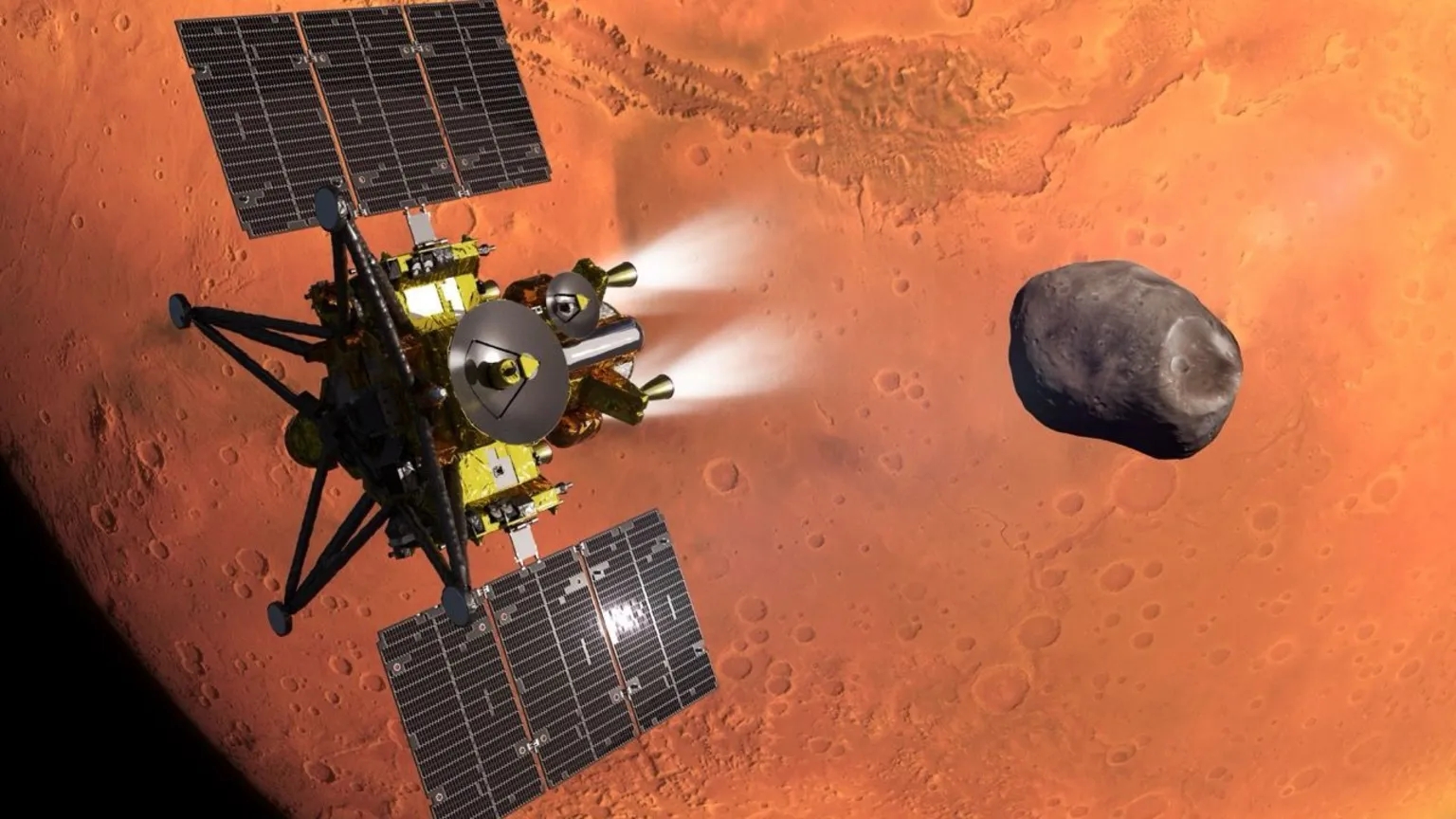
 JAXA
A space mission is set to launch on Monday that will attempt to grab a piece of Mars' moon Phobos and bring it back to Earth.
If it is successful, this will become the first time a sample has been returned from Mars or its moons to be analysed in laboratories here on Earth.
The spacecraft will blast off from Japan and arrive at Phobos in August 2027.
It is hoped that the Mars Moons Exploration (MMX) mission, which is led by the Japanese Space Agency, will solve the mystery of how Mars's moons formed.
Prof Sara Russell, from the Natural History Museum, who is the MMX mission's deputy for sample analysis, said: "There hasn't yet been a successful mission to go to Phobos and bring a bit back to Earth.
"I think this is an incredibly ambitious and fun mission," she said.

There are only three moons in the inner Solar System: our own Moon, and two around Mars, which are called Phobos and Deimos.
Both of these are tiny - Phobos is about 20km (12 miles) across and Deimos is about 10km (six miles) across. They are also irregularly shaped, looking a bit like space potatoes.
The MMX spacecraft will study Deimos as it arrives in the Mars neighbourhood, and then will focus on Phobos.
It plans to set down a small rover to explore the terrain, though this will be no easy feat.
Sara Russell says no one has ever landed a rover on such a small moon.
"The moon itself doesn't have very much of its own gravity," she explained.
"But it's next to an enormous planet that's got a much higher gravity, and that makes it much harder to get a rover onto the surface."
 NASA
The rover will scout out a landing site so that the MMX spacecraft itself can later touch down on Phobos.
Once on the surface, it will deploy a robotic arm and two samplers to grab some moon dust.
This material will be packed into a small capsule that will return to Earth in 2031, landing in the Woomera desert of South Australia.
The amount of material that will come back is tiny - just 10g.
"It's a very small [amount] actually," said Dr Chrysa Avdellidou, from Leicester University, who is working with the Japanese mission.
"However we can do several studies even on individual grains… You don't need to have kilos back from a surface in order to do science. So it's worth every gram," she said.
 JAXA
Scientists believe the sample will finally shed light on the puzzle of where Mars's moons came from.
There are two competing ideas.
Either a space rock smashed into Mars early in its history, and Phobos and Deimos were created from the debris.
Or the moons are two wandering asteroids from the outer Solar System, which were grabbed by the Red Planet's gravity.
"When we get the sample back, we'll be able to look in detail at its chemistry and its mineral composition - and the two hypotheses will produce very distinct results," said Sara Russell.
"It should be pretty much immediately obvious.. whether it's the product of this dramatic impact or whether it's a captured asteroid. So we'll find that out really quickly."
The team is also hoping there might be an extra bonus coming back to their labs.
"One of the really exciting things is that Phobos is so close to the Mars surface that whenever there's an impact into the Mars surface, little grains might actually become implanted into Phobos itself," said Russell.
"And that means that the sample we get back may actually contain grains of Mars as well. So it can give us really direct information about the composition and history of Mars."
 Kevin Church/BBC News
Bringing material from Mars back to Earth has long been an ambition of space scientists.
The Nasa Perseverance rover, which has been exploring Mars since 2021, has been carefully collecting samples on Mars and storing them in canisters.
But a second Nasa/ESA mission, called Mars Sample Return, that would have picked up and returned these canisters, has been effectively cancelled, after its funding was halted by the US Congress.
China is planning its own sampling mission to Mars, set to launch in 2028. It will attempt to return Martian material to Earth in 2031.
We do already have some fragments of the Red Planet here on Earth in the form of Martian meteorites.
These are pieces of Mars that were blasted off the surface by asteroid strikes, and ended up being hurled towards the Earth.
Martian meteorites are extremely rare, but like all space rocks that fall to our planet, they become contaminated as soon as they get here, mixing with the air, dust, soil and water.
Scientists are so desperate to get their gloved hands on a direct sample from Mars and its moons because it would be pristine.
The MMX mission is scheduled to blast off from the Tanegashima Space Center at 0441 local time on 20 October (2041BST 19 October).
SOURCE/AUTHOR : BBC NEWS/Rebecca Morelle, Alison Francis and Kevin Church, BBC News Science
Venues















'I will never let your legacy die' - Charlie Kirk's widow gives tearful address after shooting








One hellscape to another: Gazans tell of dire conditions in Israeli-declared humanitarian zone







Israeli forces near Gaza City centre as Hamas reportedly prepares for street-to-street fighting









































Soldiers threaten to seize state TV in Madagascar, presidency says, amid warnings of coup attempt


Israeli hostages and Palestinian detainees freed as Trump hails 'historic dawn' in Middle East


Israeli military's top lawyer resigns over leak of video allegedly showing abuse of Palestinian detainee







Israeli military's ex-top lawyer arrested over leak of video allegedly showing Palestinian detainee abuse










Bondi gunmen threw explosives at start of attack and practised shooting weeks before, police allege






























CJP protest: India's 'Cockroach' protesters have wounds consistent with pellet-gun fire, experts say
















Iran says it is in talks with Oman but not the US after Trump says negotiations to resume














Ethiopia's Addis Standard: Editor of top independent news site seized by police, publisher says





































Israel confirms soldiers fired at car in which Hind Rajab was killed and opens criminal investigation








UK, Canada and Australia condemn Israel for refusing criminal probe into aid worker killings in Gaza








Iran faces 'greatest financial offensive ever', says US Treasury Secretary Scott Bessent






Chinese-Eswatini relations: China advises its citizens to leave Taiwan ally over security risks





































Iran says US strike killed four at wedding in 'war crime' as US denies targeting civilians

















































Russia hits Ukrainian train shortly after Boris Johnson and top European officials leave station


























German state elections: Chancellor Friedrich Merz vows to stay on despite 'disaster' in polls









Trump threatens to 'annihilate' Iran in UN speech as officials from both countries meet on sidelines
















Russia-Ukraine war: Moscow targeting 'ordinary life' with attacks on data centres, Zelensky says




























































































Comments (0)
No comments yet. Be the first to comment!
Leave a Comment